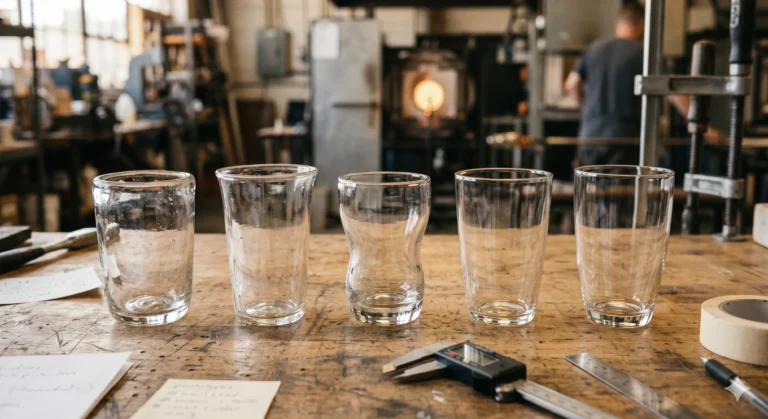
Start with the service context
Handmade glassware is not a universal answer for every hospitality setting. Its relevance depends on the intended service, product form, presentation, operating conditions, customization requirements, and approval standard.
For a restaurant group, hotel, or bar, the first question is where the product will be used and what the service team needs it to do.
Applications in dining and hospitality
Fine dining and wine service
Wine glasses, champagne flutes, decanters, and other forms may contribute to a defined tabletop presentation. Buyers should review the form, balance, handling, storage, cleaning, and consistency requirements alongside the visual direction.
The product should be evaluated in the actual service context rather than approved only from photographs.
Restaurants and all-day dining
Handmade tumblers, water glasses, or serving pieces may support a restaurant’s table setting when their appearance and handling requirements fit the service model.
Clarify the use frequency, storage approach, cleaning workflow, replacement process, and acceptable variation before selecting a product.
Cocktail bars
Custom shapes, colors, or surface treatments may help a bar create a distinctive presentation for selected drinks. The buyer should define which design details matter, how the product will be handled, and what the sample must demonstrate.
Hotels and in-room service
Bedside water sets, carafes, tumblers, and amenity glassware may be reviewed as part of the room experience. The evaluation should include housekeeping, storage, replenishment, replacement, and consistency across the relevant rooms or properties.
Where customization can add value
Hospitality buyers may consider:
- a custom silhouette or proportion
- a color or surface treatment
- etched logos or patterns
- a coordinated bottle, glass, and tray presentation
- an application-specific shape for a signature serve
The design should support the service purpose. A complex detail should remain open for physical sampling if its production or care implications are not yet known.
Evaluate the product beyond appearance
Before approval, discuss:
- how the item feels and functions in service
- whether the form fits the intended beverage or presentation
- how staff will handle and store it
- how cleaning and replenishment will work
- which differences are acceptable between pieces
- how decoration or color will be inspected
- what evidence supports any durability or performance claim
Do not assume that handmade glassware is automatically more durable, more premium, or more commercially effective. Those conclusions depend on the product and project evidence.
Use a hospitality buyer checklist
For each proposed application, define:
- service location and beverage or presentation use
- required form, capacity, or design features where already specified
- customization and branding requirements
- handling, storage, cleaning, and replacement workflow
- acceptable visual variation
- sample and approval criteria
- product-specific evidence still required
This helps design, procurement, operations, and the supplier work from the same brief.
Distinctive design still needs operational fit
Handmade character can be part of a hospitality product identity, but it should not be separated from the operating reality. A product that looks appropriate but cannot be stored, cleaned, replenished, or approved consistently may not suit the intended service system.
The right decision is therefore not “handmade or standard” in the abstract. It is whether the proposed product and process fit the buyer’s application and requirements.
Final takeaway
Handmade glassware can support dining and hospitality applications when design differentiation, service context, customization, and operational requirements are considered together. The product should be reviewed through physical samples and project-specific criteria rather than through unsupported assumptions about guest preference or commercial performance.
If you are selecting handmade glassware for a hotel, restaurant, bar, or hospitality group, prepare the service setting, product requirements, customization brief, and operating questions for a focused discussion.
Final CTA
Selecting glassware for a hospitality service setting? Share the application, product requirements, customization brief, and operating conditions so the design can be evaluated in context. Discuss a Hospitality Solution with Eukaglass.
FOR PROFESSIONAL BUYERS
Planning a Glassware Project?
Discuss product requirements, samples, sourcing, manufacturing, or OEM development with our team.