Opening: The approval gap
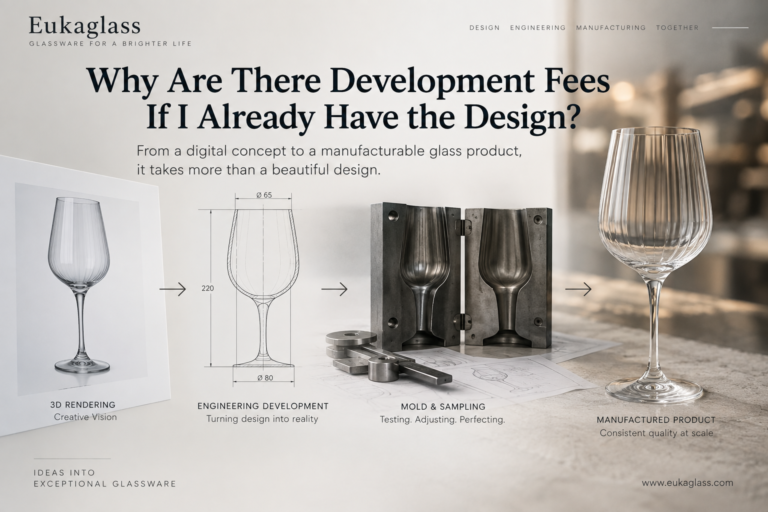
A buyer approves a beautiful glassware sample. The shape looks right, the proportions feel balanced, and the design appears ready for a production order.
Then the questions change.
Can the same result be reproduced across multiple production runs? Can different operators achieve the agreed standard? Can the product remain within an acceptable range when the order is made at the required volume and pace?
These are not the same questions as prototype approval.
A prototype proves feasibility. Production proves repeatability.
That distinction matters in any custom glassware project, and it becomes especially important when the product includes handmade forming, thin walls, complex curves, decorative finishing, or tight visual expectations.
For product developers, sourcing managers, design brands, hospitality buyers, and OEM teams, the goal is not to avoid prototypes. The goal is to use the prototype stage to identify what must be controlled before production begins.
What a prototype actually proves: feasibility
The primary job of a prototype is to show that a product can exist in physical form. It helps the development team examine questions such as:
- Can the intended shape be produced?
- Does the product function as expected?
- Do the proportions and visual details work in the real material?
- Does the physical result support the intended user experience?
A prototype turns a drawing, rendering, or design brief into something that can be handled and evaluated. It can reveal issues that are difficult to judge on paper, including the relationship between form, balance, wall distribution, rim treatment, and overall appearance.
That makes prototype approval an important development milestone.
It is not, however, proof that the same result can be reproduced under production conditions. One successful sample demonstrates possibility. It does not automatically establish a repeatable process, an agreed variation range, or a production acceptance standard.
What production proves: repeatability
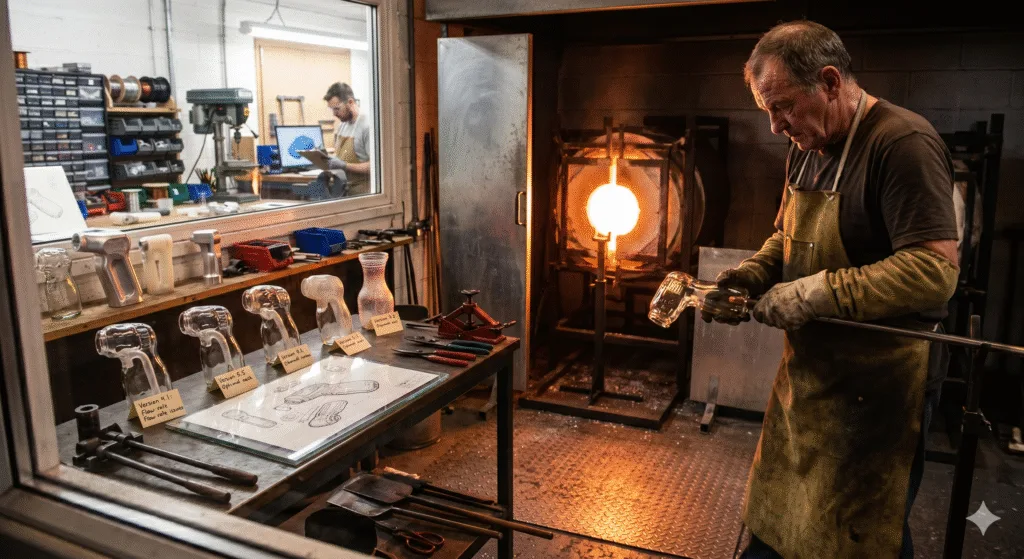
Production introduces a different set of questions. The manufacturer must reproduce the approved product repeatedly while working within the agreed process and commercial requirements.
For a custom glassware project, the buyer and manufacturer may need to discuss:
- Can key dimensions remain within the agreed range?
- Can wall-thickness distribution remain suitable for the product’s intended use?
- Can color and finish remain consistent across relevant batches?
- Can the agreed visual standard be maintained across production runs?
- Can the process be performed consistently by the operators and teams involved?
- What are the project-specific implications for yield, rework, cost, and lead time?
The last question should not be answered with a universal percentage or promise. Yield, cost, and lead time depend on the product design, process, order requirements, inspection criteria, and agreed level of variation.
This is the central difference:
A prototype validates feasibility. Production validates repeatability at the agreed standard.
Why prototype quality may not scale
Prototype work and production work often take place under different conditions.
Conditions that may differ during sampling
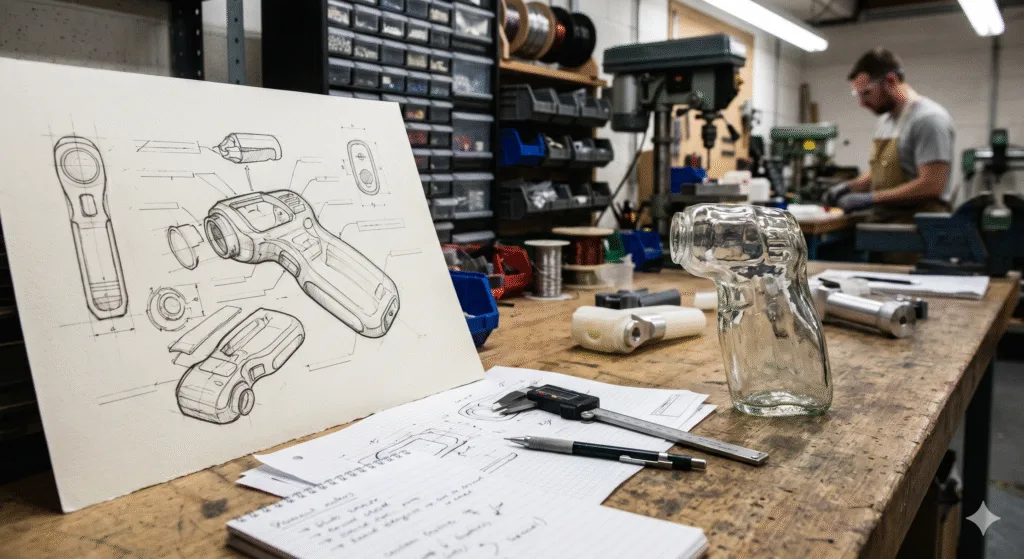
A prototype may receive unusually close attention. For example, the sample may involve:
- An experienced operator or craftsperson
- More time per piece than production allows
- Manual selection or rework during development
- A particular material batch
- A subjective approval decision based on one physical sample
These conditions do not make the prototype invalid. They simply mean that the sample represents a specific set of development conditions.
Conditions that must be considered during production
An order must be evaluated as a system. Relevant considerations can include:
- Operator and shift variation
- Material-batch variation
- Target throughput
- Inspection and recording methods
- Rework and rejection decisions
- The project-specific balance between appearance, function, cost, and lead time
Production is therefore more than repeating a successful action once. It is the process of maintaining an agreed result when the surrounding conditions change within the normal scope of the project.
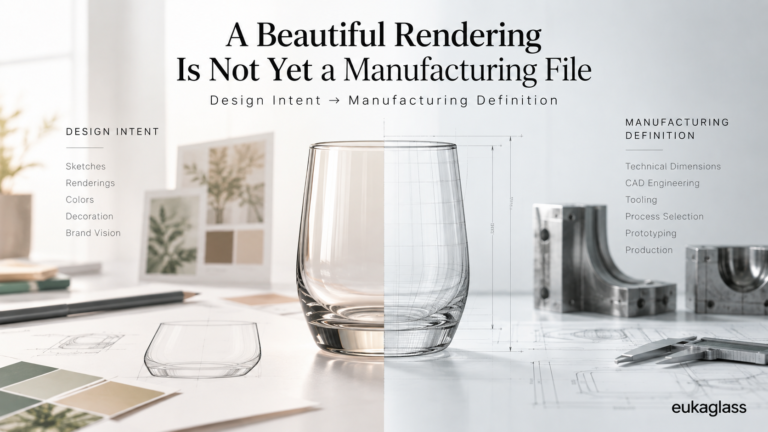
Drawings also need to be used carefully. They define design intent and geometry, but a physical glass sample introduces material behavior, reflection, tactile perception, and process variation. In handmade development, a drawing alone should not become the only pass/fail standard for every visible detail.
Handmade glassware and realistic variation
Handmade glassware makes the approval gap easier to see because the process can involve direct operator decisions and physical shaping. Small differences may appear in areas such as:
- Rim finishing
- Curvature and transitions
- Wall-thickness distribution
- Visual symmetry and roundness
- Decorative treatments
- The way clarity and surface details appear under different lighting
This does not mean that handmade glassware has no quality standard. It means that the quality standard must be defined for the specific product and process.
A buyer may need to decide which features are measured, which are judged visually, and which differences are acceptable in actual use. A reference sample can help, but the parties should also agree how the reference will be used during inspection and production approval.
Universal tolerances should not be assumed. The realistic range depends on the design, forming method, material, finishing requirements, and intended application. If a product includes an especially thin rim, complex transition, or layered decoration, the project team should discuss the production implications before the design is locked.
Best effort versus process capability
A prototype is often a capability demonstration under defined conditions. Production requires a process that can hold the agreed result over time.
For a buyer, repeatability is not established by one impressive sample. It is better examined through questions such as:
- Has the result been reproduced across more than one run?
- Can more than one operator or team achieve the agreed standard?
- What changes between prototype and production?
- Are tooling, staffing, cycle time, or inspection methods different?
- How will variation be recorded and discussed?
The term “process capability” should be used precisely. It should describe the ability of the agreed production process to deliver the agreed product standard within the project’s operating conditions. It should not be treated as a general promise about every product or every order.
Where relevant, repeatability can be discussed through multiple production samples, reference comparisons, inspection records, and an agreed decision process. Formal metrics should only be used when the project has the data and definitions needed to support them.
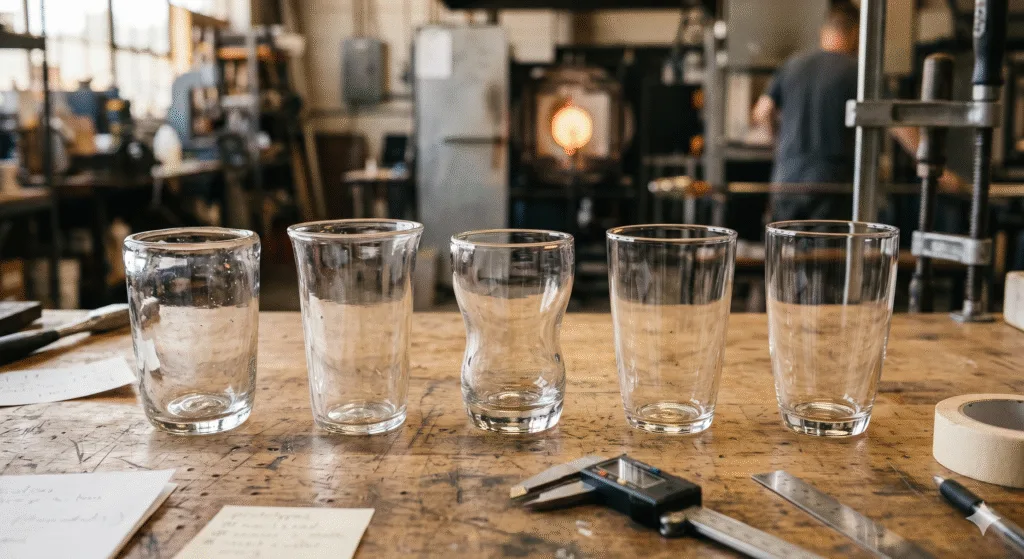
Prototype approval versus production approval
These are separate milestones and should be documented separately.
Prototype approval
Prototype approval may confirm that:
- The design direction is understood
- The physical shape can be produced
- The intended function and appearance can be evaluated
- The team is ready to discuss production conditions
Production approval
Production approval should address the agreed product standard, process conditions, acceptable variation, and inspection method. It should make clear what will be measured, what will be judged visually, and how the approved reference sample will be used.
Purchase-order readiness
Before a purchase order is placed, the buyer and manufacturer should understand the relationship between design intent and production reality. They should also identify which details could affect rework, yield, cost, or lead time for the specific project.
Approval is stronger when both sides understand what “acceptable” means before the order is scaled.
Buyer checklist before scaling
Validate repeatability
- Has the result been reproduced across more than one run?
- Can more than one operator or team achieve it?
- What changes between the prototype process and the production process?
- Will tooling, staffing, cycle time, or quality-control methods change?
Define tolerances and acceptable variation
- Which features will be measured?
- Which features will be judged visually?
- What reference sample controls the comparison?
- What level of variation is acceptable for the product’s intended use?
- How will the buyer and manufacturer handle a result that is technically usable but visually different from the reference?
Pressure-test yield, cost, and lead time
- Which design details create the greatest production risk?
- What assumptions could affect yield or rework for this project?
- Which features could affect cost or lead time?
- Could a process adjustment improve stability without changing the design intent?
- What information is still unknown before production approval?
These questions are not a substitute for project-specific technical review. They are a way to make the important decisions visible before scaling.
OEM development takeaway
The strongest OEM development process connects four elements early:
- Design intent
- Manufacturing method
- Acceptable variation
- Production approval criteria
When these elements remain separate, a buyer may approve a sample while the manufacturer is still working out how to reproduce it consistently. When they are discussed together, the team can identify which features need additional sampling, clearer references, or a more carefully defined inspection approach.
For Eukaglass, the relevant starting point for a custom glassware discussion is not a generic promise of perfect production. It is a clear understanding of the product brief, intended application, sampling requirements, acceptable variation, and production expectations.
Final takeaway
A perfect prototype is an important milestone, but it is only the beginning of the manufacturing journey.
A prototype proves possibility. Production proves repeatability.
For product teams, that means discussing repeatability before the design is locked. For buyers, it means aligning on references, inspection criteria, and acceptable variation before placing the order. For manufacturers, it means understanding how the agreed result will be maintained across the actual production process.
Before you scale a custom glassware design, validate how it will repeat.
If your project depends on handmade production, custom shaping, controlled variation, or a specific reference sample, discuss the development requirements before production approval. A useful starting point is the design intent, target application, acceptable variation, sampling requirements, and production expectations.
Discuss an OEM development project
FOR PROFESSIONAL BUYERS
Planning a Glassware Project?
Discuss product requirements, samples, sourcing, manufacturing, or OEM development with our team.