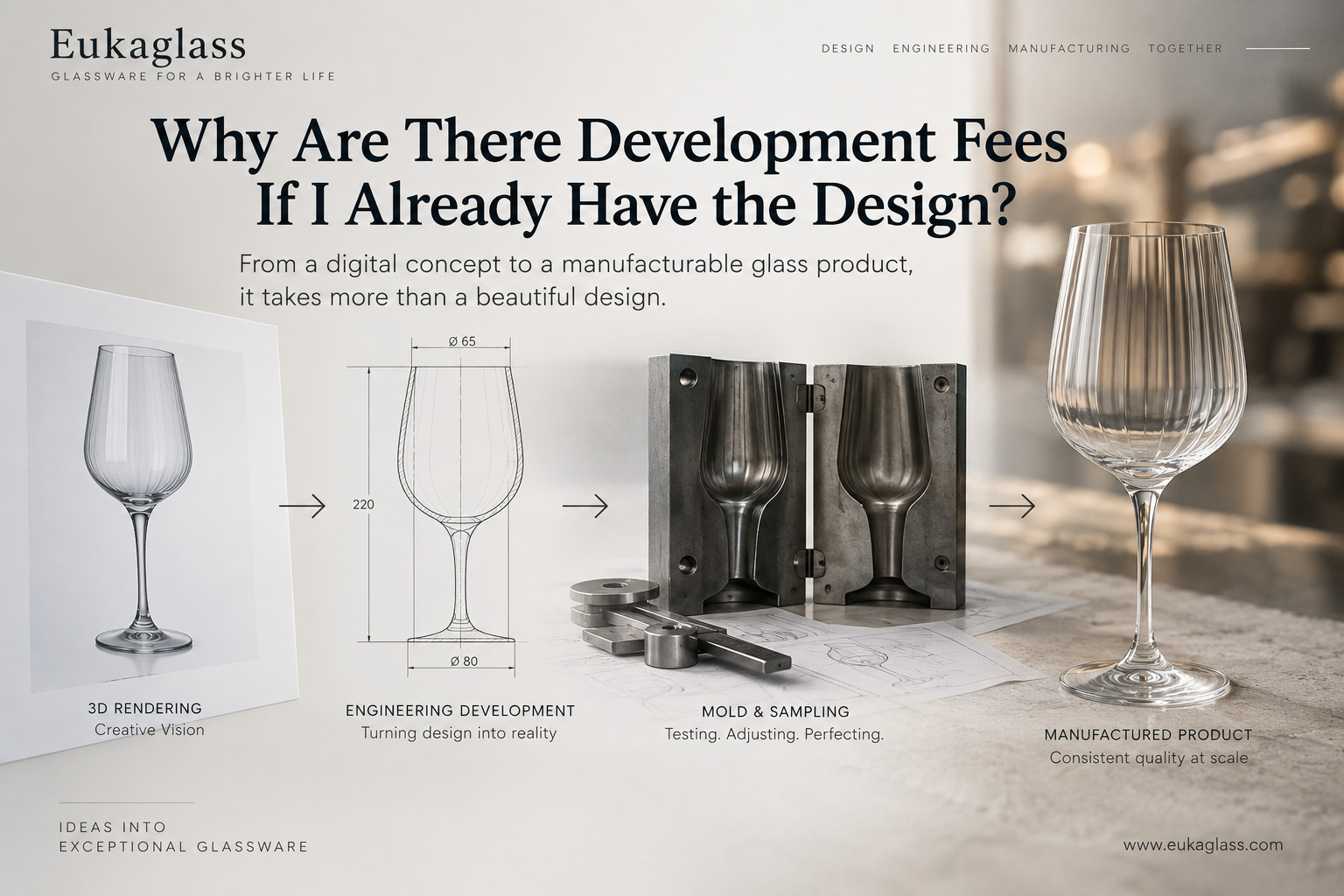
Development fees cover the engineering, tooling decisions, artwork adaptation, prototyping, testing, and production validation needed to turn a finished design into repeatable glassware.
For many B2B buyers and brand managers, submitting a high-resolution 3D render or a vector file feels like the end of the creative process. If the design is already finished, why does a custom glassware OEM partner charge a “development fee”?
A brand may have already invested heavily in designers, artwork, and complete product concepts. From that perspective, paying for “development” again can sound like paying twice for the same work.
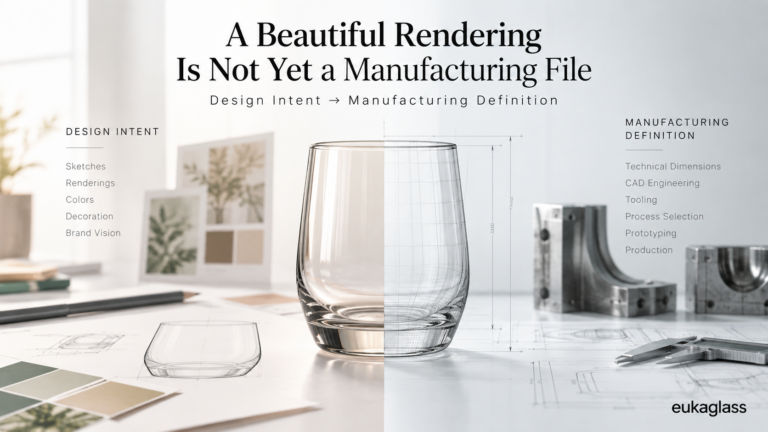
However, you are not paying for the same design twice. The answer lies in the critical distinction between creative design (what the product looks like) and manufacturing development (how the product is physically made, stabilized, and mass-produced). Translating a digital concept into a repeatable, high-quality glass vessel requires a complex engineering phase that bridges the gap between digital art and industrial reality.
The Bridge Between Creative Vision and Physical Reality
Creative design focuses on aesthetics, brand language, and user experience. Manufacturing development, however, focuses on solving a different set of physical challenges:
- Thermal Dynamics: How molten glass behaves and cools without cracking or forming uneven walls.
- Structural Integrity: Ensuring the glass can withstand pressure, maintain its center of gravity, and survive daily use.
- Tooling Strategy: Determining the exact mold structures and draft angles required to release the glass safely without defects.
- Decoration Precision: Adapting flat artwork to account for the physical distortions of curved glass surfaces.
Case Studies: Why “Perfect” Designs Still Need Engineering
To illustrate why this development phase is a necessary investment, let’s look at two real-world scenarios from our production floor.
Case Study 1: The Full-Coverage Decal Disconnect
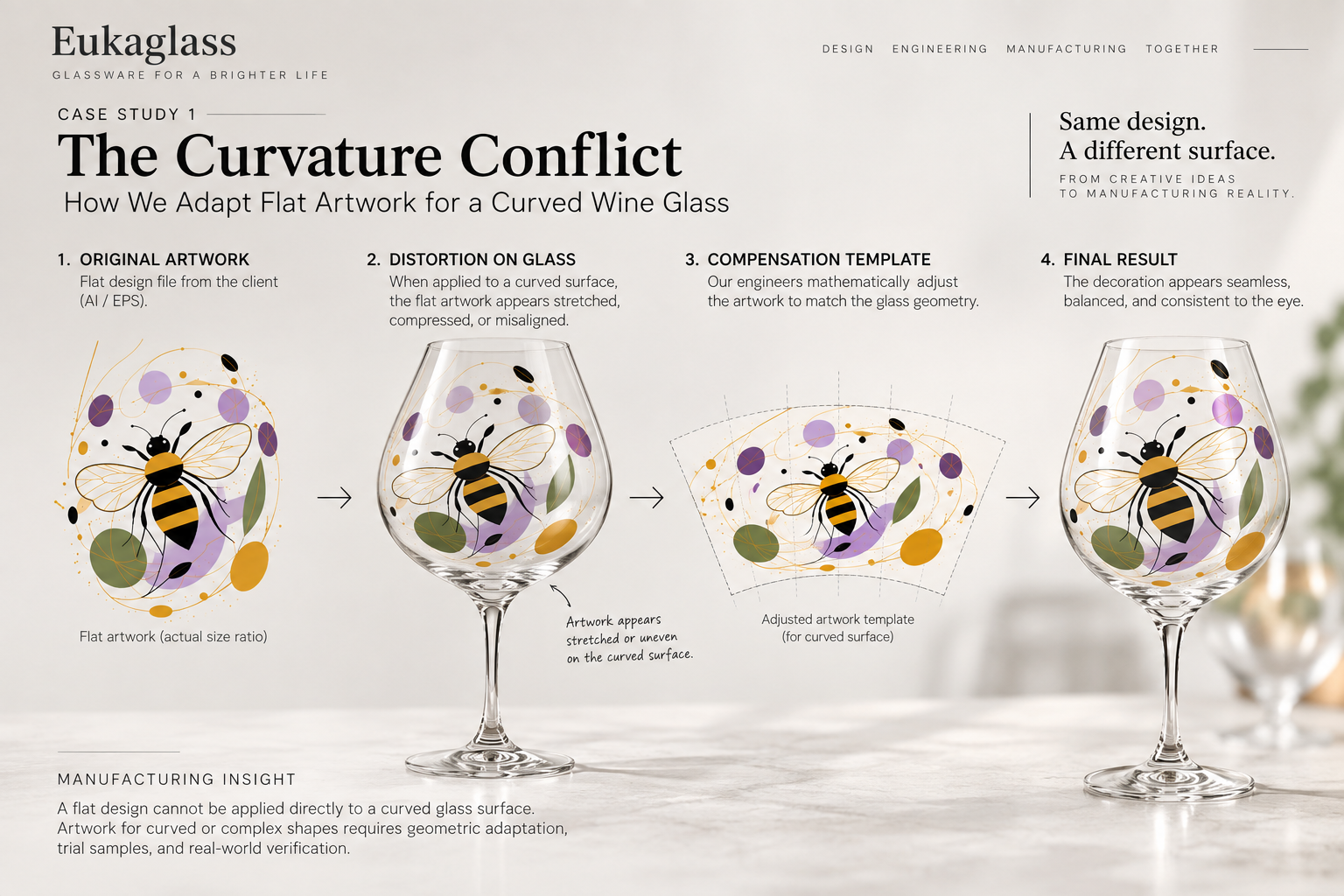
Many brands make a critical sequence error: they finalize their 2D decoration artwork before confirming the physical glass shape.
The Reality: An American client provided us with a stunning, finalized design featuring a large, complete bee motif intended to fully wrap around the glass. However, they subsequently selected a goblet with a highly curved bowl. When flat artwork is applied to a compound curve, you cannot simply “stretch” the file in design software. If applied directly, the bee motif would severely distort, wrinkle, or misalign.
The Development Work: To realize the client’s vision, our engineers had to completely deconstruct the original artwork based on the exact curvature of the physical goblet. We mathematically split the bee decal into two separate, highly calculated components. This allowed our craftsmen to apply the decals to the curved surface seamlessly, ensuring the bee remained visually intact without any distortion or broken lines after the high-temperature firing process. This engineering translation is exactly what the development fee covers.
Case Study 2: The AI-Generated Decanter
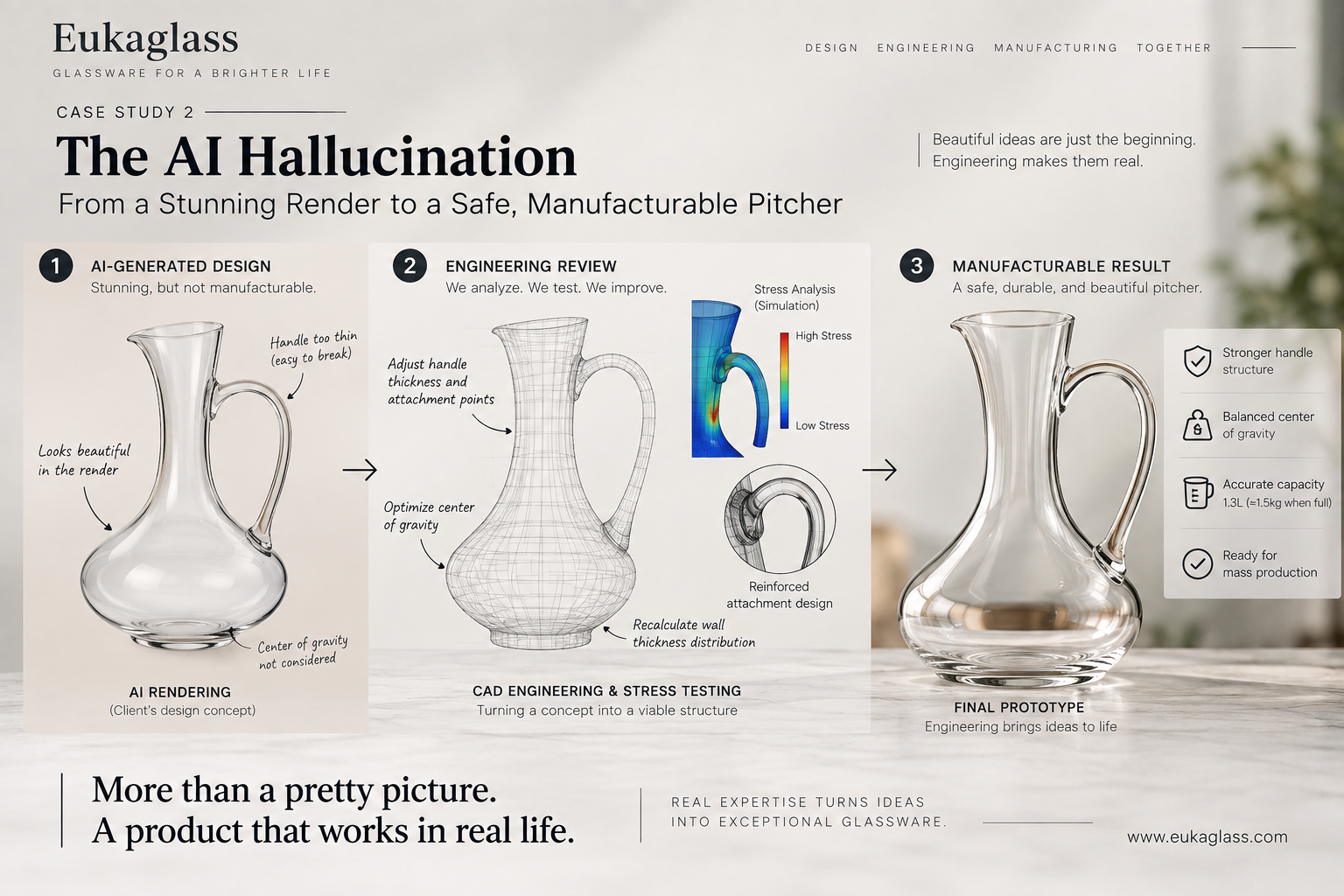
With the rise of generative AI, clients frequently bring us breathtaking concept images accompanied by basic target dimensions, asking us to immediately open molds for production.
The Reality: A European client provided an AI-generated image of a complex decanter. While AI understands aesthetics, it does not understand fluid dynamics or glassmaking constraints. If we had blindly cut molds based on the provided dimensions, the internal capacity would have been entirely inaccurate, and the intricate surface details would have locked the product inside the mold.
The Development Work: Our mold engineers recalculated the overall dimensions and internal volume to guarantee the target capacity. More importantly, based on the AI’s decorative details, the client’s target mass-production volume, and assembly line logistics, our team had to engineer a specific tooling strategy. We analyzed the design to determine whether an open-and-shut mold or a block mold was the viable path forward. The development fee funded the critical engineering required to turn “virtual pixels” into a manufacturable, physical reality without wasting thousands of dollars on failed tooling.
What Are You Actually Paying For?
You are paying for the engineering, tooling, decoration development, and physical validation required to make the design production-ready.
That technical infrastructure includes:
- Technical CAD Engineering: Translating concept images into high-precision manufacturing blueprints that dictate dimensions, tolerances, and fluid distribution.
- Tooling & Process Planning: Determining the correct mold structures (e.g., open-and-shut vs. block molds) and creating the initial physical molds used for sampling.
- Decoration Optimization: Deconstructing, remapping, and testing artwork for curved surfaces, alongside color matching and firing trials.
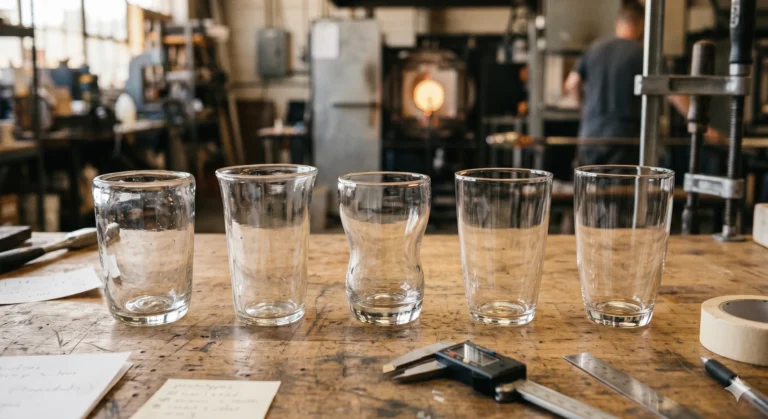
- Prototyping: The physical creation of samples used to validate dimensions, appearance, decoration, and manufacturing feasibility before final production approval.
Understanding Your Investment: The Four Types of Costs
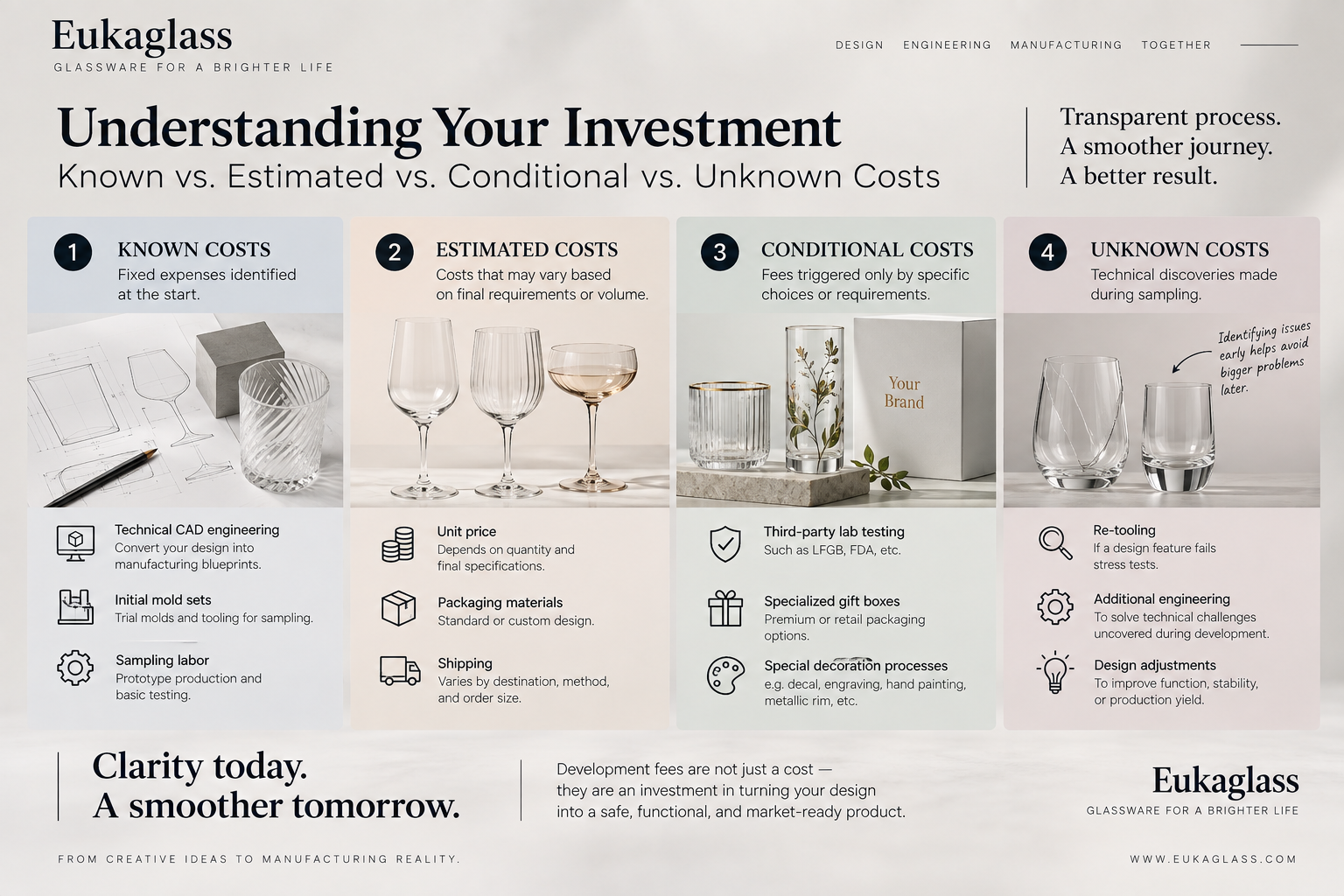
Custom development naturally contains uncertainty, but professional suppliers should make costs as transparent as possible before work begins. Development costs generally fall into four categories:
- Known Costs: Fixed expenses identified at the start, such as standard CAD engineering fees, initial mold sets, and sampling labor.
- Estimated Costs: Preliminary estimates that depend on engineering details (like packaging materials or shipping), where a range is provided rather than a fixed number.
- Conditional Costs: Fees triggered only if a particular condition occurs, such as needing specialized third-party testing (LFGB/FDA) or special decoration processes.
- Unknown Costs: Technical discoveries that genuinely cannot be predicted until physical testing begins, such as re-tooling if a design feature fails stress tests.
Handling Design Changes vs. Technical Discoveries
When additional work appears during development, it is crucial to understand why it is happening.
- Design Change: If a client changes the fundamental geometry, capacity, or decoration direction after development has begun, this creates a new scope of work. Additional fees are standard here because the engineering process must restart.
- Technical Discovery: If our team discovers that an artwork pattern splits during firing or a glass wall thins out unexpectedly in the mold, this is a technical discovery. We transparently present the findings, the alternatives, and the engineering solutions required to fix it.
What Evidence Should Buyers Receive for a Development Fee?
Buyers should receive visible, reviewable evidence at every development stage, including drawings, tooling plans, decoration proofs, physical prototypes, and revision records.
Before approving the work, buyers should confirm what evidence will be delivered at each stage and who is responsible for approving it.
| Development evidence | What it should confirm | Buyer approval point |
|---|---|---|
| Dimensioned engineering drawing | Overall dimensions, critical tolerances, target capacity, wall distribution, rim and base geometry | Before mold production |
| Tooling plan | Mold type, parting strategy, draft requirements, release risks, and the expected sampling route | Before tooling is cut |
| Decoration adaptation proof | Artwork scale, split lines, print or decal placement, color reference, and treatment of curved surfaces | Before decoration trials |
| Physical prototype | Appearance, usable capacity, balance, handling, dimensions, and compatibility with the intended decoration | Before production approval |
| Inspection and revision record | What was measured, what changed, why it changed, and which version is approved | At every revision gate |
This evidence turns a development fee from an abstract charge into a controlled engineering process. It also gives both parties a shared reference if the design, tooling, decoration, or production assumptions change.
Who Should Expect a Development Fee?
Brands, product developers, sourcing teams, retailers, hospitality groups, and packaging engineers should expect a development fee when a project requires new engineering, tooling, testing, or production validation.
Manufacturing development is most relevant when a project includes one or more of the following:
- A new glass shape, custom capacity, or non-standard proportions
- Complex relief, texture, handles, stems, closures, or assembly requirements
- Artwork that must wrap around a curved or irregular surface
- Tight dimensional requirements for packaging, filling lines, lids, or accessories
- A prototype that must be validated before a larger production commitment
- Multiple decoration techniques, special colors, or third-party testing requirements
The primary audience is therefore brand owners, product developers, sourcing teams, retailers, hospitality groups, and packaging engineers creating a product that does not yet exist as a production-ready item.
When Might a Development Fee Not Be Necessary?
A full development fee may not be necessary when the buyer accepts an existing production-proven item, its current specifications, and a standard decoration method.
Sampling, decoration, freight, or testing costs may still apply, but the engineering scope is smaller because the glass itself is already production-proven.
The practical question is not simply whether a design file exists. It is whether the requested product, tooling, decoration, and approval criteria already exist in a form that can be repeated in production.
Development Fee FAQ
Is a development fee the same as a design fee?
No. A design fee covers the creative concept, while a development fee covers the engineering and validation needed to make it producible.
This may include tooling decisions, artwork adaptation, sampling, testing, and technical revisions.
Can a 3D rendering be used directly to make a mold?
No. A 3D rendering communicates visual intent, but it cannot replace a dimensioned engineering model and manufacturing validation.
Mold production normally requires verified capacity, tolerances, draft, wall behavior, and a workable release strategy.
What should be agreed before development starts?
Before development starts, both parties should agree on deliverables, costs, revision limits, approval gates, sample quantities, and tooling ownership.
The quotation should also explain estimated or conditional costs and what happens if the buyer changes the design.
How can a buyer control development risk?
Buyers can control development risk by approving the project in stages and recording written approval at every decision gate.
The usual sequence is the engineering drawing, tooling plan, undecorated prototype, decoration proof, and final production sample. This makes later changes easier to price and trace.
Accelerate Your Time-to-Market with Eukaglass
Original products require development. Engineering, tooling, and decoration trials represent highly specialized, real-world work. Trying to bypass this critical development phase almost always results in higher risks, delayed launches, and costly mass-production failures.
Understanding the “why” behind development fees ensures a smoother, more predictable manufacturing journey. At Eukaglass, we specialize in turning complex creative visions into retail-ready glassware with industrial precision.
Ready to see your design in reality?
Thanks to our rigorous upfront engineering and deep integration with Qixian’s glassmaking supply chain, for suitable projects, we can complete the first physical prototype in as fast as 15 days, depending on tooling, decoration, and development requirements. Let our engineering team handle the technical hurdles between your rendering and the assembly line.
Start Your Custom Glassware Project with Eukaglass Today ↗
FOR PROFESSIONAL BUYERS
Planning a Glassware Project?
Discuss product requirements, samples, sourcing, manufacturing, or OEM development with our team.