For custom glassware projects, packaging should not be treated as the final step. Starting packaging development earlier can reduce sampling delays, improve supplier coordination, and prevent packaging from becoming a bottleneck before mass production.
In many custom glassware projects, most of the early attention goes to the product itself.
The development team focuses on questions such as:
- Is the glass shape correct?
- Has the color been approved?
- Is the decoration positioned properly?
- Do the accessories fit?
- Does the finished sample match the original design?
These questions are important. But another development process needs to move alongside the product:
Packaging development.
When packaging discussions begin too late, a project can reach an unexpected situation:
The product sample is almost ready, but the project is still not ready for final approval.
This is especially common in projects involving multiple production processes, surface decoration, accessories, retail packaging, or several specialized suppliers.
The issue is not simply how long packaging takes. The real issue is when packaging development begins.
Packaging Has Its Own Development Timeline
Packaging is sometimes treated as something that happens after the product has been approved.
For simple stock products, this approach may work. For customized products, it can create unnecessary delays.
A retail packaging program may involve:
- Packaging structure development
- Product measurement
- Protective insert development
- Material selection
- Artwork and printing
- Barcode and label positioning
- Regulatory information
- Packaging sampling
- Shipping carton configuration
- Drop or transport testing when required
Each step has its own lead time.
Some steps depend on final product specifications, but others can begin before the product is completely approved.
This is why product development and packaging development should usually overlap rather than run one after another.
A Final Packed Sample Is More Than a Packaging Sample
One of the easiest things to underestimate during custom product development is what it takes to produce a final packed sample.
From a buyer’s perspective, the request may sound simple:
“Please put the final product into the final packaging and send us one complete sample.”
But that sample may require much more than producing a box.
Consider a customized glassware project involving:
Glass Production → Surface Finishing → Decoration → Accessories → Packaging → Final Assembly
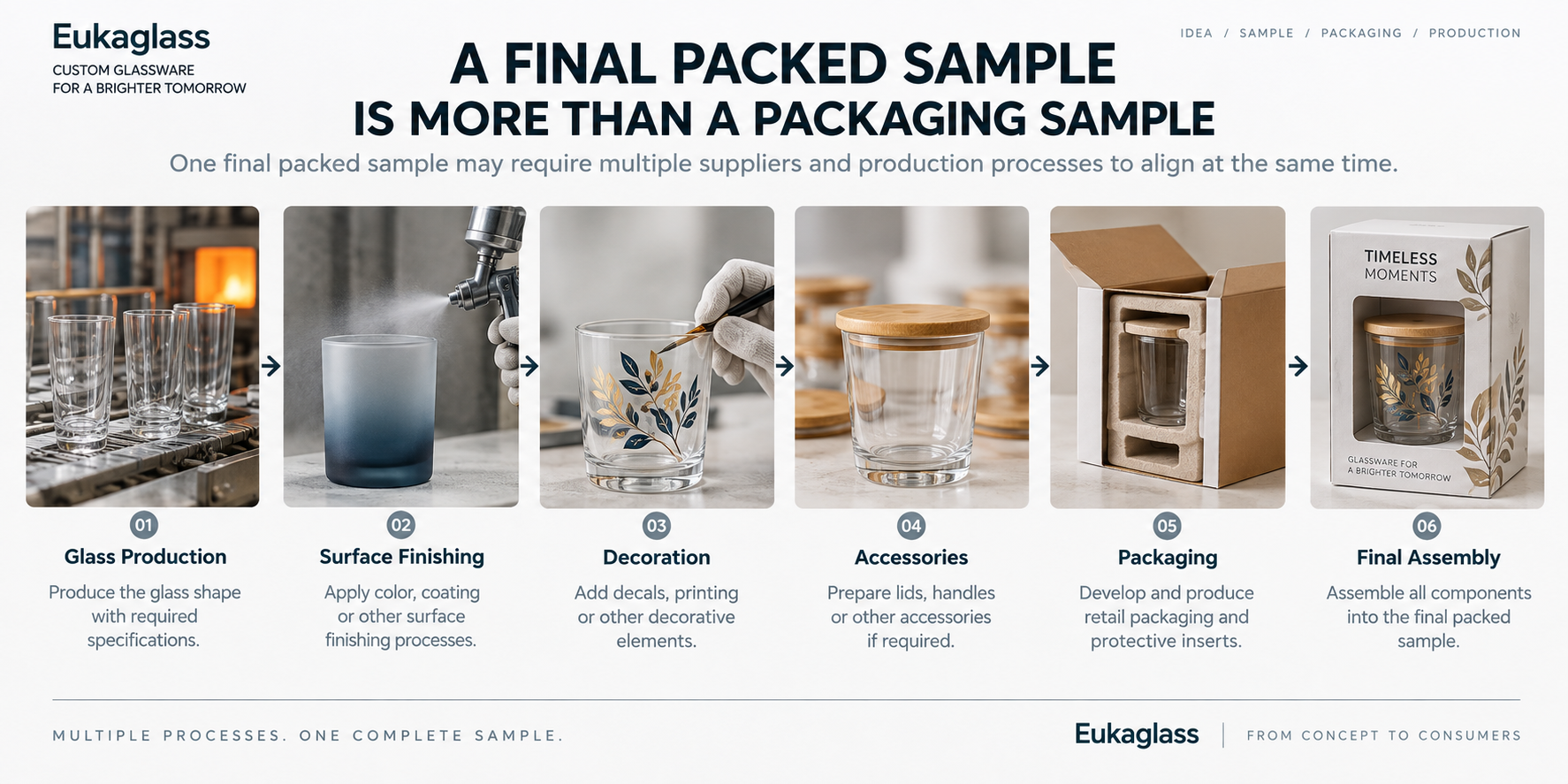
To create the final packed sample, all these components need to be available at the same time.
If finished components from the previous sampling stage are still available, assembly may be relatively straightforward.
If they are not, suppliers may need to reproduce individual components simply to complete one final packed sample. This could mean restarting glass production, finishing, decoration, accessory preparation, packaging production, inspection, and final assembly.
What appears to be one packaging sample can therefore become a small multi-supplier production project.
Why One Custom Sample Can Be Difficult to Schedule
If a factory can manufacture thousands of pieces, why can it be difficult to produce one additional sample?
Because sampling capacity and mass-production capacity are different.
A production order is organized around a scheduled run. The factory prepares raw materials, tooling, production lines, operators, finishing processes, inspection, and packaging for continuous production.
A custom sample works differently.
Producing one customized sample may require a supplier to:
- Locate or reproduce a semi-finished product
- Prepare a very small amount of material
- Schedule a non-standard operation
- Arrange an experienced operator
- Restart a decoration or finishing process
- Coordinate with another supplier
- Wait for curing, firing, drying, or assembly
The quantity may be small, but the number of processes involved can remain almost the same.
What looks like one sample to the buyer may require the manufacturer to restart a miniature supply chain.
This becomes even more difficult when sampling overlaps with:
- Peak retail delivery periods
- Holiday shutdowns or Chinese New Year
- Factory maintenance or capacity constraints
- Material shortages
A realistic development schedule should therefore consider not only how many days each process requires, but also whether production capacity will be available when that process needs to begin.
The Real Problem Is Sequencing, Not Packaging
Starting packaging development earlier does not mean finalizing packaging before the product is ready.
Packaging dimensions, inserts, protective structures, and artwork positioning may depend on the final product specifications.
A small change in glass diameter, height, stem length, handle dimensions, accessory size, or product weight can affect the packaging structure.
The objective should not be:
Finalize packaging as early as possible.
It should be:
Start packaging development as early as practical, then finalize it when the product specifications are locked.
That distinction is important.
How to Develop Custom Glassware and Packaging in Parallel
For many custom glassware projects, a more practical process can be divided into four stages.
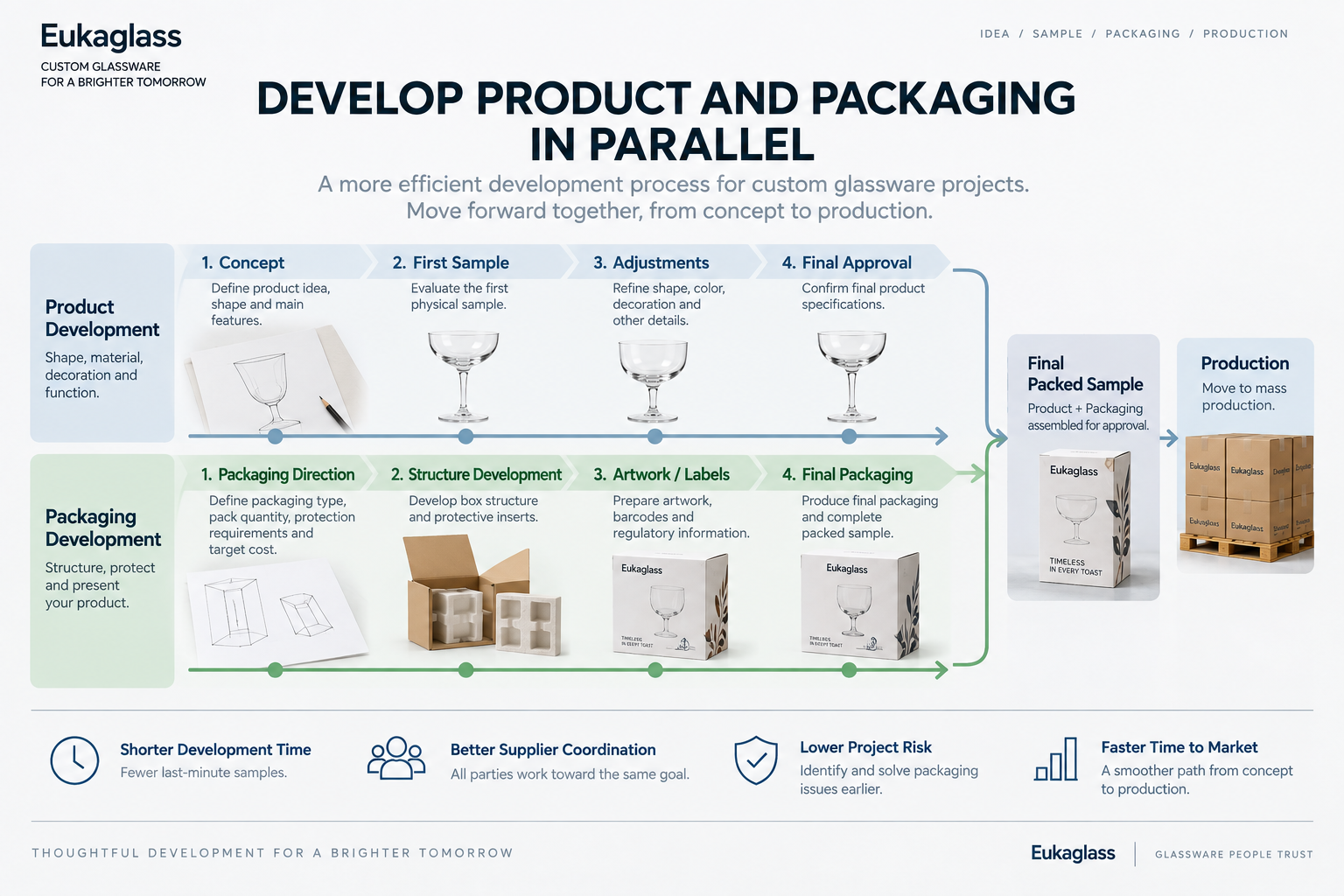
Stage 1: Confirm the Product Concept
Once the general product concept is clear, begin discussing the packaging direction.
At this stage, buyers and suppliers can define:
- Retail, gift, e-commerce, or bulk packaging
- Number of pieces per pack
- Basic protection requirements
- Sustainability or plastic-free requirements
- Target packaging cost
- Whether a final packed sample will be required
Exact dimensions do not need to be confirmed yet.
The objective is to establish the packaging strategy and identify which decisions may affect the project schedule.
Stage 2: Evaluate the First Product Sample
Once the first physical product sample is available, packaging development can become more specific.
The team can begin evaluating:
- Approximate product dimensions and weight
- Box structure
- Insert design
- Protection around vulnerable areas
- Product positioning
- Retail presentation
At this stage, a structural sample or white-box prototype can often be developed.
This allows the packaging concept to be tested before time and money are spent on final printed packaging.
Stage 3: Continue Packaging Work During Product Adjustments
The product may still require changes, but that does not mean all packaging work needs to stop.
Tasks that can often continue in parallel include:
- Artwork development
- Barcode preparation
- Label positioning
- Packaging material selection
- Sustainability information
- Master carton planning
Independent tasks should move forward while product details are being finalized.
This reduces the risk of packaging becoming a new critical path after product approval.
Stage 4: Finalize Packaging After Product Approval
Once the product dimensions and specifications are locked, the packaging can be finalized.
The final packed sample can then combine:
- Final glass product
- Final color and decoration
- Final accessories
- Final protective insert
- Final printed packaging
- Final labels and assembly
At this stage, the final packed sample serves its proper purpose:
Confirmation before mass production.
It should not be the first time the packaging concept is being developed.
Sequential vs. Parallel Development
Sequential Development
Product Development → Product Approval → Packaging Development → Packaging Sample → Final Packed Sample → Production
This process may look organized, but it creates a long critical path.
If a packaging problem appears late in the project, the entire schedule may stop.
Parallel Development
Product Development + Packaging Development → Final Product Approval → Final Packaging Confirmation → Final Packed Sample → Production
Wherever tasks are independent, they move forward together.
This approach can provide:
- Better supplier coordination
- Earlier identification of packaging problems
- Fewer last-minute samples
- Lower scheduling risk
- Faster transition to mass production
For complex OEM glassware projects, parallel development is often the more practical model.
Packaging Planning for Handmade Glassware
Packaging planning is particularly important for handmade glassware because the product is fragile and small dimensional variations may occur between individual pieces.
Packaging therefore needs to consider:
- Maximum product dimensions
- Appropriate clearance
- Rim, stem, and base protection
- Product movement inside the box
- Divider and insert strength
- Carton stacking
- Shipping conditions
A package that fits one perfect prototype too tightly may not be suitable for normal production variation.
For this reason, custom glassware packaging should involve both product engineering and production knowledge. It should not be treated only as a graphic design task.
Custom Glassware Packaging Checklist
Before reaching the final packaging sampling stage, buyers should ideally confirm:
| Item | Key Question |
|---|---|
| Packaging format | Is the product intended for retail, gifting, e-commerce, or bulk supply? |
| Pack quantity | How many pieces will be included in each pack? |
| Product dimensions | Are the product dimensions sufficiently stable? |
| Protective insert | Is a custom protective structure required? |
| Artwork and labels | Are artwork, barcodes, and regulatory details confirmed? |
| Sustainability | Are FSC, plastic-free, or other material requirements specified? |
| Transport testing | Is drop testing or other transport testing required? |
| Final packed sample | Is a complete retail-ready sample required before production? |
| Timing | Could sampling overlap with peak production periods? |
The earlier these questions are discussed, the easier it becomes to build a realistic project timeline.
For complex custom products, the number of processes involved is often a better indicator of development complexity than the number of samples required.
Packaging Is Part of Product Development
Packaging is often described as the last stage before production.
For many custom products, that description is misleading.
Packaging is not simply what happens after product development. It is part of product development.
It does not need to be finalized before the product is approved. But it should be discussed and developed early enough to move alongside the product wherever possible.
A good development schedule should ask two questions:
How long will each step take?
And, just as importantly:
Which steps can begin in parallel?
That change in planning can prevent a common situation:
The product is ready—but the project still isn’t.
Developing a Custom Glassware Project?
Eukaglass works with brands, retailers, hospitality businesses, and product development teams on custom glassware manufacturing and OEM development.
From handmade glassware and custom decoration to sampling, packaging development, and production coordination, we help align the stages required to move a product from concept toward mass production.
If you are developing a custom glassware project, share your product concept, target quantity, decoration requirements, and packaging direction with our team. We can help identify a practical development sequence for sampling, packaging, and production.
FOR PROFESSIONAL BUYERS
Planning a Glassware Project?
Discuss product requirements, samples, sourcing, manufacturing, or OEM development with our team.