Custom glassware is a product decision, not only a branding decision
For a design-led brand, premium retailer, or corporate gift buyer, glassware is part of the product experience. Its shape, surface treatment, color, and packaging can influence how the recipient understands the brand.
Custom glassware is therefore more than placing a logo on a standard item. It is an OEM development decision that should connect the intended brand identity with a product that can be sampled, evaluated, and produced to an agreed standard.
Where customization can support brand identity
Decoration and understated branding
Etched logos, monograms, and other surface details can provide a recognizable brand cue without making the product feel like a promotional object. The final effect depends on the glass form, decoration method, artwork, and intended use, so these details should be reviewed on a physical sample.
Shape and proportion
The silhouette of a tumbler, stemmed glass, carafe, or gift set can communicate a different product character. A design-led brand may need a distinctive shape, while a hospitality buyer may place greater weight on handling, service use, storage, and repeat ordering.
The important question is not which shape is most fashionable. It is whether the proposed form supports the brand, the application, and the production brief.
Color and visual accents
Colored rims, bases, patterns, or mass-colored glass may help a collection connect with a defined visual language. Color decisions should be communicated through an agreed reference and evaluated under appropriate conditions before approval.
Text, taglines, and messages
Text can be useful for a corporate gift or limited collection, but legibility, placement, artwork scale, and the chosen decoration process need to be considered together. A concise mark is usually easier to evaluate than an overloaded surface.
Different buyers, different priorities
Design-led brands
Design-led brands may prioritize a recognizable silhouette, controlled details, and a product that feels consistent with the wider collection. The development brief should state which features are essential and which can change if sampling reveals a production constraint.
Premium retailers and e-commerce buyers
Retail buyers may need differentiation at shelf or online, while also considering usability, packaging, handling, and repeatability across replenishment orders. Customization should support the product proposition rather than add detail that is difficult to explain or reproduce.
Corporate gift buyers
Corporate and premium gift buyers may need a clear relationship between the recipient, occasion, quantity, artwork, and delivery plan. A useful brief should clarify whether the priority is a subtle executive gift, a commemorative item, or a coordinated set.
Hospitality and beverage brands
Hotels, restaurants, bars, wineries, and breweries may use custom glassware as part of service presentation. In these settings, the design should be reviewed alongside handling, cleaning, storage, and the operating environment.
A practical custom glassware brief
Before asking for a sample, define:
- target buyer and application
- preferred glass type and approximate form
- logo, artwork, color, or other customization
- functional requirements that cannot change
- features that are open to development
- expected order structure and repeat-order needs
- packaging or presentation requirements
- how the sample will be reviewed and approved
This gives the manufacturer a clearer basis for discussing feasibility and sample priorities.
Keep customization useful and producible
Customization is strongest when it improves recognition without undermining the product’s function. A complex graphic, unusual form, or multi-step finish may be visually attractive, but the buyer should understand what must be validated physically before final approval.
The first sample should answer practical questions: Does the shape feel right? Is the decoration placed as intended? Does the item support its use case? Which details must remain fixed for the next development step?
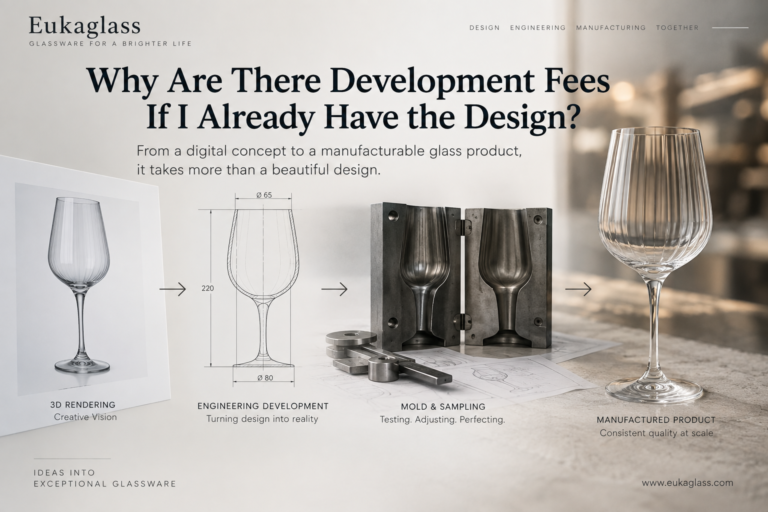
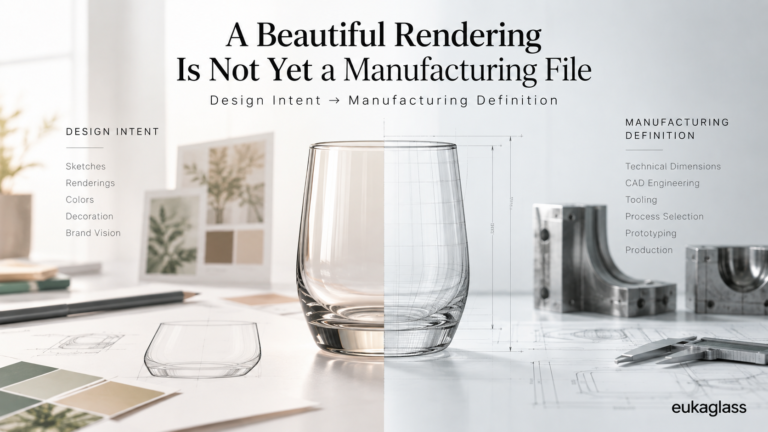
The appropriate production method, repeatability, finish, and acceptance criteria depend on the specific project. They should be agreed with the manufacturer rather than assumed from a drawing or reference image.
Final takeaway
Custom glassware can strengthen a brand identity when the design, application, and production brief point in the same direction. For design-led brands, premium retailers, and corporate gift buyers, the goal is not simply to make a glass look branded. It is to develop a product that communicates the right value and can be evaluated clearly before an order is placed.
If you are developing a branded glassware item, share the intended application, target customer, artwork, preferred form, and non-negotiable requirements for an OEM development discussion.
Final CTA
Planning a branded glassware project? Share your application, artwork, preferred form, and buyer requirements so the development conversation can begin with a clear product brief. Discuss OEM / Custom Development with Eukaglass.
FOR PROFESSIONAL BUYERS
Planning a Glassware Project?
Discuss product requirements, samples, sourcing, manufacturing, or OEM development with our team.