Start with the buyer requirement, not a marketing label
Terms such as “crystal,” “crystalline,” and “lead-free” can carry different expectations for different buyers. A design-led brand may focus on clarity, proportion, and table presentation. A hospitality buyer may also need information about handling, cleaning, food contact, documentation, and the intended service environment.
The first step is to define what the product must achieve and which evidence is required. A material name alone is not a complete technical specification.
Separate questions buyers need answered from claims that require evidence
Before approving a material or supplier, ask:
- What is the material designation used for this product?
- Which composition information can the supplier document?
- What visual and tactile characteristics are required?
- Which product dimensions or thin-wall features are essential?
- What food-contact, safety, or regulatory documentation applies?
- Which tests were performed, on which product, and under which method?
- Does the evidence apply to the proposed production design?
These questions create a review path without assuming that a particular chemical composition or performance outcome is correct.
Review visual and functional requirements separately
A buyer may use terms such as brilliance, clarity, resonance, thinness, or elegance to describe the desired product. Those terms should be translated into observable product requirements and, where necessary, measurable or documented criteria.
For example, the team may need to decide whether the priority is:
- appearance under the intended lighting
- transparency or color neutrality
- a particular rim or wall profile
- perceived weight and balance
- tactile comfort
- service or cleaning requirements
- a documented material or compliance standard
The relevant evidence depends on the product and intended use. A visual impression should not be presented as proof of refractive performance, safety, durability, or chemical stability.
Understand the role of sampling
A physical sample allows the buyer to evaluate the actual form, surface, optical appearance, and handling impression. It does not, by itself, prove composition, long-term performance, production repeatability, or compliance.
During sampling, record:
- the material description supplied for the sample
- the features being evaluated visually
- the tests or documents still required
- the product and process differences that may exist at production scale
- the approval criteria for the next stage
This keeps material selection connected to both product development and supplier verification.
Questions about composition and optical performance
If a supplier describes a glass as lead-free crystalline or associates it with a particular optical or acoustic property, request the supporting documentation before using the claim in product or marketing copy.
The buyer should clarify:
- which composition or material definition is being used
- whether the stated composition is a target, a measured result, or a specification
- which laboratory or test method supports the statement
- whether the result applies to the final product, not only a raw material or sample
- which claims require an independent review
No chemical explanation, composition percentage, refractive value, acoustic value, or safety conclusion should be inferred from the product name alone.
Connect material review to the OEM brief
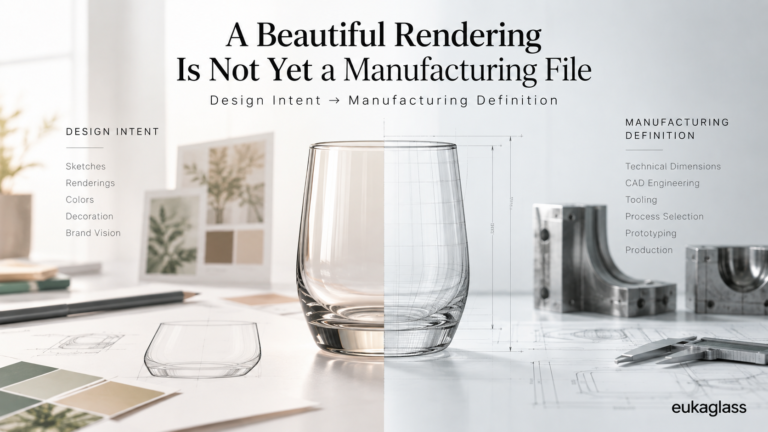
For a custom project, the material conversation should sit alongside the design and application brief. Define:
- product form and intended use
- appearance and tactile priorities
- thin-wall or lightness requirements, if applicable
- decoration or finishing requirements
- cleaning and service environment
- required documentation and approval tests
- features that are non-negotiable
The manufacturer can then identify which questions can be answered from existing documentation and which need sampling or project-specific testing.
Use documented evidence for compliance and safety
Food-contact, safety, and regulatory requirements are not established by a general reference to “international standards.” The applicable requirement depends on the market, product, material, use, and current legal framework.
Before publication or purchase approval, verify the relevant jurisdiction, standard, test method, certificate or report, issuing body, product scope, and validity. Do not present FDA, EFSA, CE, RoHS, lead-content, leaching, or customs-compliance statements without evidence that applies to the proposed product.
A buyer’s material-approval checklist
Before approving a crystalline glassware material, confirm:
- the buyer’s actual material and product requirements
- the supplier’s documented material designation
- the sample’s relationship to the proposed production product
- visual and functional acceptance criteria
- required composition or laboratory evidence
- relevant food-contact and regulatory documentation
- open questions about manufacturing, finishing, cleaning, or use
- who gives final technical and commercial approval
Final takeaway
Premium glassware material selection should be evidence-led. A label such as lead-free crystalline may begin the conversation, but the buyer still needs to define the intended product result and confirm which composition, performance, safety, and compliance claims are supported.
If you are comparing materials for a premium glassware project, share the product brief, intended market, appearance requirements, and documentation needs for a focused material and OEM review.
Evaluating a lead-free crystalline material?
Share the target application, intended market, product requirements, and evidence needed so the material discussion can be reviewed without assuming unsupported claims. Discuss material requirements with Eukaglass.
FOR PROFESSIONAL BUYERS
Planning a Glassware Project?
Discuss product requirements, samples, sourcing, manufacturing, or OEM development with our team.