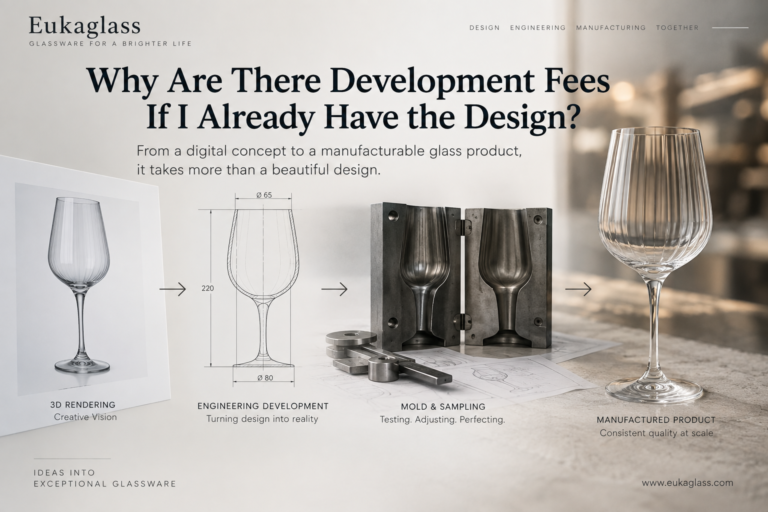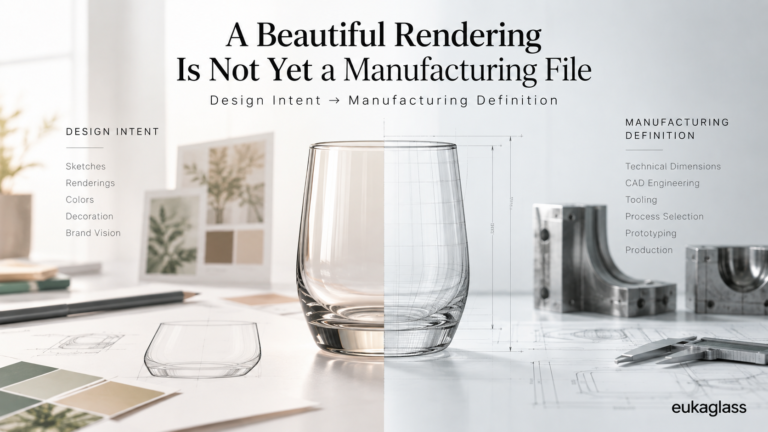
Why some handmade-glass decisions need a physical prototype
In handmade glass development, early technical discussions are often informed by experience and probability rather than complete certainty. Buyers understandably want decisions confirmed before sampling, but some questions can only be evaluated properly when the first physical prototype exists.
This is especially relevant to rim finishing, edge treatment, bottom curvature, visual balance, perceived weight, and the relationship between the design and real glass.
Drawings and renderings define design intent. They cannot fully predict how a physical handmade-glass object will look, feel, or respond to light.

What drawings cannot show completely
A solution may be technically feasible on paper and still feel wrong when produced. Physical evaluation can reveal:
- reflections under actual lighting
- wall-thickness distribution
- perceived weight in the hand
- edge comfort at the lip
- subtle shape or visual differences that only become apparent in the physical sample
- overall proportion in the finished glass
Glass is optical, tactile, and physical at the same time. That is why some design decisions should remain open until the buyer and manufacturer can review a real sample.

Separate early feasibility decisions from physical-perception decisions
Not every decision needs to be finalized at the same stage.
Decisions to clarify early
The development team should identify issues that affect tooling, interfaces, structural feasibility, intended function, and the production approach. These matters may influence whether the proposed design can move into sampling and should not be left undefined by accident.
Decisions to evaluate after the first prototype
Other questions depend on physical evidence, including:
- rim comfort
- visual balance
- reflections in the intended environment
- perceived elegance or heaviness
- tactile feel
- the relationship between shape and actual use
The exact decision boundary depends on the design and process. The purpose is to make uncertainty visible, not to postpone every decision.
Treat V1 as a learning prototype
The first prototype does not need to answer every question at once. It should help the team learn about variables that drawings cannot fully predict, such as comfort, balance, optics, perceived weight, and the consistency of multiple pieces where relevant.
If V1 is treated as a final pass/fail test without agreed evaluation criteria, the team may request revisions before understanding what the sample is showing. A clearer approach is to record what the prototype is intended to validate and what remains open for the next decision.
Define what “better” means before revising
Sampling loops often become inefficient when the optimization target changes from one comment to the next. Before requesting a revision, align on the primary issue:
- comfort
- visual proportion
- stability
- consistency
- production feasibility
- cost or lead-time constraints
The relevant priority should be tied to the project brief. A change that improves one attribute may affect another, so the buyer and manufacturer should discuss the trade-off before treating the revision as a final requirement.

A prototype-first decision framework
Before requesting changes, ask:
- What problem are we solving?
- How will success be evaluated?
- Is this a tooling, function, or physical-perception decision?
- Do we already have evidence from a real sample?
- What trade-off is acceptable for this project?
- Which decision must be confirmed before the next sampling step?
This framework helps turn sampling from an open-ended debate into a structured learning process.
How this differs from production-repeatability review
Physical prototyping and production approval answer different questions. This article focuses on why certain handmade-glass design decisions cannot be finalized before physical evidence exists.
Post 314 addresses the next distinction: why a successful prototype does not automatically prove repeatability in production. Once a design has been physically evaluated, the buyer and manufacturer still need a separate conversation about production conditions, acceptable variation, and approval criteria.
[RELATED ARTICLE: Post 314 — Why a “Perfect” Prototype Can Still Fail in Production]
Final takeaway
Experience can narrow the possibilities, but a physical prototype reveals what actually works in the real object. In handmade glass development, the goal is not to confirm everything before sampling. It is to reduce uncertainty strategically, decide what must be locked early, and use the prototype to evaluate the questions that drawings cannot settle.
If you are developing a handmade-glass product, prepare the design intent, non-negotiable functional requirements, open perception questions, and the criteria for reviewing the first physical prototype.
Preparing a handmade-glass prototype?
Share the design intent, functional requirements, open physical questions, and review criteria so the first sample can support a focused OEM decision. Discuss OEM / Custom Development.
FOR PROFESSIONAL BUYERS
Planning a Glassware Project?
Discuss product requirements, samples, sourcing, manufacturing, or OEM development with our team.