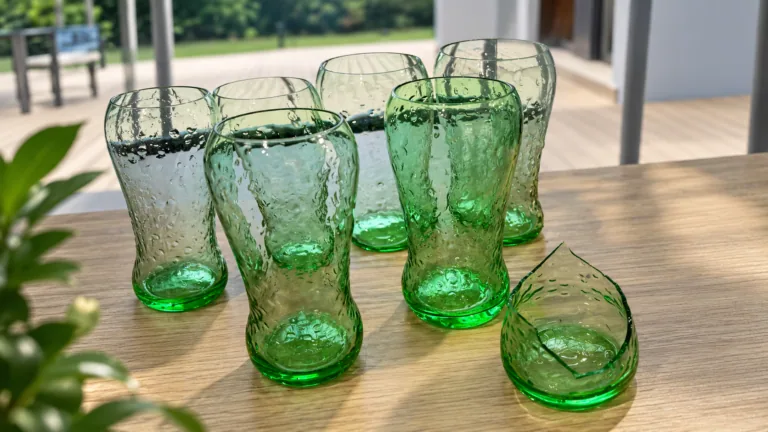
Production method should follow the product brief
When selecting a glassware production method, buyers should begin with the product they need rather than a general preference for handmade or machine-made production.
The relevant method depends on factors such as the intended form, decoration, application, order structure, development requirements, acceptable variation, and the evidence needed for approval. No method is automatically the right choice for every product.
1. Machine-blown glass
Machine-blown glass uses mechanical blowing and a mold or forming system to create a defined shape. It may be relevant when the project requires a repeatable formed design and a production process suited to the intended order structure.
Buyer questions include:
- Does the proposed form suit the available forming process?
- Which dimensions and visual features need to be controlled?
- What level of customization can the tooling support?
- How will the approved sample relate to production output?
Claims about efficiency, cost, volume, uniformity, or performance should be confirmed for the specific factory and product.
2. Machine-pressed glass
Machine-pressed glass forms molten glass through mechanical pressure and a mold. It may be considered for products where the design, surface pattern, structural requirements, and production method are compatible.
Before approval, clarify:
- whether the desired detail can be formed accurately
- how the mold affects the final surface and geometry
- which features are measured or visually inspected
- whether the proposed product suits its intended use
Do not assume that machine-pressed glass is always thicker, stronger, cheaper, or more durable. Those outcomes depend on the design, material, process, and project requirements.
3. Hand-blown glass
Hand-blown glass is shaped by an artisan using a manual forming process. It may be relevant when the brief calls for a distinctive form, development flexibility, visible craft character, or a design that needs hands-on sampling.
The buyer should define:
- which design features are essential
- which variation is acceptable
- what the sample must demonstrate
- how the product will be evaluated in its intended application
- which questions remain open until physical sampling
Hand-blown production should not be described as automatically more premium, more durable, or more suitable for every low-volume or high-value project.
4. Spun glass
Spun glass can refer to a manual or machine-assisted forming approach in which rotation contributes to the shape. It may be relevant to some thin-walled or lightweight designs, but the suitability of the method must be confirmed against the product brief and process capability.
Ask the supplier to clarify:
- which spinning method is proposed
- what form and wall profile the process can support
- how the sample is produced
- which features require physical validation
- how the intended production process differs from sampling
Do not infer lightness, uniformity, production speed, cost, or durability from the word “spun” alone.
Compare methods by buyer decision criteria
Instead of asking which method is best, compare each method against the project.
Product design
Can the method create the required shape, profile, surface, and decoration? Which features are fixed by tooling or process, and which can be adjusted during development?
Application
Will the product be used in hospitality, retail, gifting, events, or another setting? The relevant handling, presentation, storage, and care requirements should be defined before method approval.
Volume and repeatability
What order structure and repeatability standard does the project require? Confirm supplier-specific volume, process, scheduling, and acceptance assumptions rather than using universal figures.
Customization
Does the method support the required color, decoration, shape, branding, or finishing? Additional processes may change the sampling and approval sequence.
Evidence and approval
Which features will be checked through drawings, physical samples, measurements, visual references, or product-specific tests? Make the approval standard clear before scaling.
A practical comparison workflow
Before selecting a production method:
- Define the application and buyer requirements.
- Identify the essential design and functional features.
- Ask the supplier which methods are technically relevant.
- Review physical samples made using the proposed method.
- Define acceptable variation and inspection criteria.
- Confirm project-specific volume, timing, cost, and production assumptions.
- Record which claims still require verification.
Final takeaway
Machine-blown, machine-pressed, hand-blown, and spun glassware are not interchangeable labels. Each method creates a different set of questions about form, customization, application, sampling, repeatability, and approval.
The strongest sourcing decision is the one that matches the method to the product brief and records what the supplier can demonstrate for the specific project.
If you are comparing glassware production methods, share the intended form, application, customization requirements, order structure, and approval criteria for a focused manufacturing discussion.
Choosing a production method for a glassware project?
Share the product brief, intended application, customization requirements, and approval standard so the relevant forming options can be evaluated. Discuss manufacturing requirements with Eukaglass.
FOR PROFESSIONAL BUYERS
Planning a Glassware Project?
Discuss product requirements, samples, sourcing, manufacturing, or OEM development with our team.